Showing posts with label Designers. Show all posts

Sunday, 15 March 2015

Women's Action Coalition (WAC)

Beautiful posters for Women's Action Coalition by Bethany Johns.
Visit her website here, here or here


http://www.bethanyjohns.com/Women-s-Action-Coalition-WAC-1
http://www.bethanyjohns.com/Women-s-Action-Coalition-WAC


Friday, 16 January 2015

Beatrice Warde in Her Own Voice


Listen to Beatrice Warde as she speaks on Australian radio.
http://www.typeradio.org/#/519

The First Female Typographer


Read this wonderful article by John Boardley on the beginnings of typography at ‘I Love Typography’


Monday, 9 December 2013

Mildred Friedman


Known to many as Mickey, Mildred Friedman served as the editor of Design Quarterly and was the Walker Art Center design curator for much of the ’70s and ’80s. She organized a series of groundbreaking exhibitions, sometimes in collaboration with Martin Friedman, such as Sottsass/Superstudio: Mindscapes (1973); New Learning Spaces and Places (1974); Nelson/Eames/Girard/Propst: The Design Process at Herman Miller (1975); De Stijl, 1917–1931: Visions of Utopia (1982); The Architecture of Frank Gehry (1986), the architect’s first major museum exhibition; Tokyo: Form and Spirit (1986), featuring the work of Japanese designers such as Arata Isozaki, Tadanori Yokoo, Toyo Ito, Tadao Ando, and Eiko Ishioka; Architecture Tomorrow (1988–1991), a series of installations undertaken by Frank Israel, Morphosis, Todd Williams/Billie Tsien, Stanley Saitowitz, Diller+Scofidio, and Steven Holl; and Graphic Design in America: A Visual Language History (1989), the first large-scale museum survey of the field in the United States.

Read more here.

Wednesday, 12 June 2013

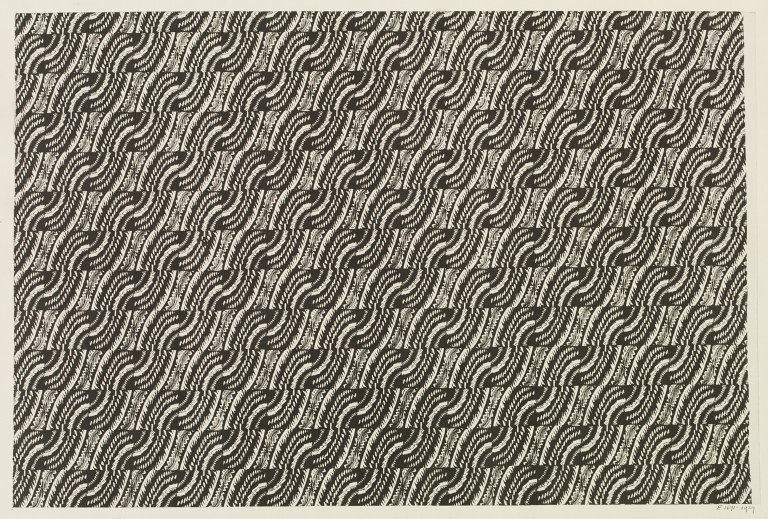
Enid Marx


Designer and artist Enid Marx’s work can be viewed in the V&A collection. More biographical information can be found on her Wikipedia page or her obituary in The Independent.

Wednesday, 27 March 2013

Barbara Nessim: An Artful Life


Check out this exhibition of feminist illustrator Barbara Nessim

Barbara Nessim
15 February – 19 May 2013
V&A Museum, London
Free admission

Watch an interview vimeo with her here

Tuesday, 18 December 2012

Stefi Kiesler


Stefi Kiesler, American born Austria, 1900–63

Stefi Kieser was a participant in and theorist of De Stijl (the Style), a group of European artists and architects who advocated for a standardized and technical art that would transcend personal taste in favor of what its members saw as art's geometric founding principles. Kiesler argued that, to achieve true objectivity, members of De Stijl should abandon traditional painting. She employed this methodology in creating 'typo-plastic' drawings using only a typewriter. Kiesler published several of these works in the journal De Stijl, under the male pseudonym Pietro de Saga. By 1931 she and her husband, the artist, architect, and designer Frederick Kiesler, had settled in New York. There Stefi Kiesler worked at the New York Public Library, where she helped Katherine S. Dreier, cofounder of the Société Anonyme, conduct research for the collection's catalogue. A little bit more info here or here.

With thanks to Antony Hudek for the tip.

Saturday, 21 July 2012

Gunta Stölz


A weaving student at the Bauhaus. More info on www.guntastolzl.org and wikipedia.


Saturday, 16 June 2012

Shirley Craven


Born in Hull in 1934, Shirley Craven studied art at Hull College of Art and then printed textiles at the Royal College of Art, 1955-58.

In 1959, aged 25, she started work at Hull Traders, a textiles firm founded two years earlier in Willesden, London, by entrepreneur Tristam Hull, who had ‘ambitious artistic aspirations’, (Jackson, 2007, p.104). In 1963, she became Chief Designer and a Director of the firm, where she worked for nearly two decades. In 1960 Design magazine described the company as having a ‘high reputation for producing adventurous and exciting designs’, which they attributed to the tight control of Craven, who displayed a ‘dramatic and original handling of colour and pattern’ (Design, 1960, p.185)

Check out the Flickr account that features some of her work here, or the book about the Hull Traders here.

Saturday, 28 April 2012

Jacqueline de Jong

Dutch artist and graphic designer Jacqueline de Jong joined the Situationist International in 1960. De Jong suggested the publication of an English language newsletter in November of 1960, to be co-edited with British Situationist Alexander Trocchi. The publication was widely discussed at Situationist conferences in 1961, and the first issue of The Situationist Times was published in May of 1962. De Jong was determined to produce 'a completely free magazine, based on the most creative of the Situationist ideas'.

An exhibition of The Situationist Times opens in at Boo Hooray in New York on 9 May 2012.
More information here or here.


Sunday, 25 March 2012

Nicolete Gray

‘Nicolete Gray's life was marked by many and diverse achievements, but it is as the historian and advocate and exponent of lettering that she will be chiefly remembered.’ Read the rest of her obituary from The Independent in 1997 here.

Feminist Design is Caring, Inclusive, Relational

‘There is a prevalent notion in the professional world that only if you have eight or more uninterrupted hours per day can you do significant work. But if you respond to other human beings… you never really have eight uninterrupted hours in a row. Relational existence is only attached to gender by history – not by genes, not by biology, not by some essential ‘femaleness’. … A relational person allows notions about other people to interrupt the trajectory of thinking or designing…’
(Sheila Levrant de Bretteville, ‘Feminist Design is Caring, Inclusive, Relational’, interview by Ellen Lupton, Eye 8, p.14) Read the whole article here.


Friday, 23 March 2012

Nat Hunter

Nat Hunter of Tokyo Digital 'maintains that women can be apologetic for themselves, whereas successful men have opinions and egos, and aren’t afraid to put them across. She stresses the importance of women being assertive with their opinions.' Read a little bit more here. Comments please!

Friday, 16 March 2012

Gudrun Zapf von Hesse

Can someone please fill in the Wikipedia on Gudrun Zapf von Hesse?
Her page is tiny compared to that of her husband, Hermann Zapf.
I think this is a photo of her:

Here are some of her typeface designs:


Monday, 5 March 2012

Beatrice Warde and The Crystal Goblet

Beatrice Warde was an American typographer, editor and educator who spent much of her working life in England. Warde published her investigations on the origins of the Garamond typeface in The Fleuron (then edited by Stanley Morison) under the pen-name Paul Beaujon. She described 'Paul Beaujon' as 'a man of long grey beard, four grandchildren, a great interest in antique furniture and a rather vague address in Montparesse.' After publishing her discovery of Garamond's origin, "Paul Beaujon" was offered a part-time post in 1927 as editor of the Monotype Recorder, and Warde accepted—to the astonishment of Lanston Monotype Corporation executives in London, who were expecting a man. She was promoted to publicity manager in 1929, a post she retained until her retirement in 1960.

Her famous and influential essay on typography "The Crystal Goblet" was first delivered as a speech, called "Printing Should Be Invisible," given to the British Typographers' Guild at the St Bride Institute in London, on October 7, 1930. The essay calls for increased clarity in printing and typography. It has has since been reprinted many times and is a touchstone for the concept of "clear" typography and the straightforward presentation of content. Throughout the essay, Warde argues for the discipline and humility required to create quietly set, "transparent" book pages. Read more on Beatrice Warde here.

This Is a Printing Office, by Beatrice Warde, 1932.

Monday, 27 February 2012

Elaine Lustig Cohen

Congratulations to Elaine Lustig Cohen (1927) for receiving an AIGA medal.
More of images of her work can be found here or here.

Plaster showcase of Clarendon, 1957

Euclid typeface, 2005

Friday, 24 February 2012

A Strange Way to Look at a House

If Otto Neurath has a monograph dedicated to him (Otto Neurath – The Language of Global Polis), the work of Marie Neurath deserves at least a mention (especially since she is hardly mentioned at all in the book above). She trained as a mathematician and worked on developing a system for visualising social information, which she named Isotype (International System Of TYpographic Picture Education) with long-time collaborators Otto Neurath and Gert Arntz.


Isotype Revisited
Hyphen Press

"We have all been inside a house, but how different it looks when it is cut through with our magic knife!" spread from book If you could see inside (Marie Neurath, 1948, from the 'Wonders of the modern world' series, London: Max Parrish)


How long do animals live? from Compton's Pictures Encyclopedia, Chicago, 1940 edition

Sunday, 5 February 2012

Guerrilla Girls

Who are the Guerrilla Girls?
“We’re a bunch of anonymous females who take the names of dead women artists as pseudonyms and appear in public wearing gorilla masks. We have produced posters, stickers, books, printed projects, and actions that expose sexism and racism in politics, the art world, film and the culture at large. We use humor to convey information, provoke discussion, and show that feminists can be funny. We wear gorilla masks to focus on the issues rather than our personalities. [...] We could be anyone; we are everywhere.”


Women’s Design + Research Unit

‘The Women’s Design + Research Unit was established in the mid 90s, at a time when the graphic design profession was undergoing massive changes and the introduction and spread of new technologies was revolutionising the industry forever. Highlighting the role of women in design and in particular, their relationship to new technology, WD+RU also set out to condemn traditional male power structures in design.’


Read an interview with Teal Triggs and Siân Cook of Women’s Design + Research Unit on Birdwatching.

Thursday, 2 February 2012

Good Design is Feminist Design

An interview with the awesome Sheila Levrant de Bretteville.
broadrecognition.com/arts/good-design-is-feminist-design-an-interview-with-sheila-de-bretteville/
Two video interviews be found here and here.